Setu
Setu
Setu
Research & Interaction Design
Research & Interaction Design
Research & Interaction Design
2025
2025
2025
5 Weeks
5 Weeks
5 Weeks
A platform helping waste workers earn, track, and take control. The project below is a case study, it’ll take you about 10 minutes to read through.
A platform helping waste workers earn, track, and take control. The project below is a case study,
it’ll take you about 10 minutes to read through.
A platform helping waste workers earn, track, and take control. The project below is a case study, it’ll take you about 10 minutes to read through.
The Story
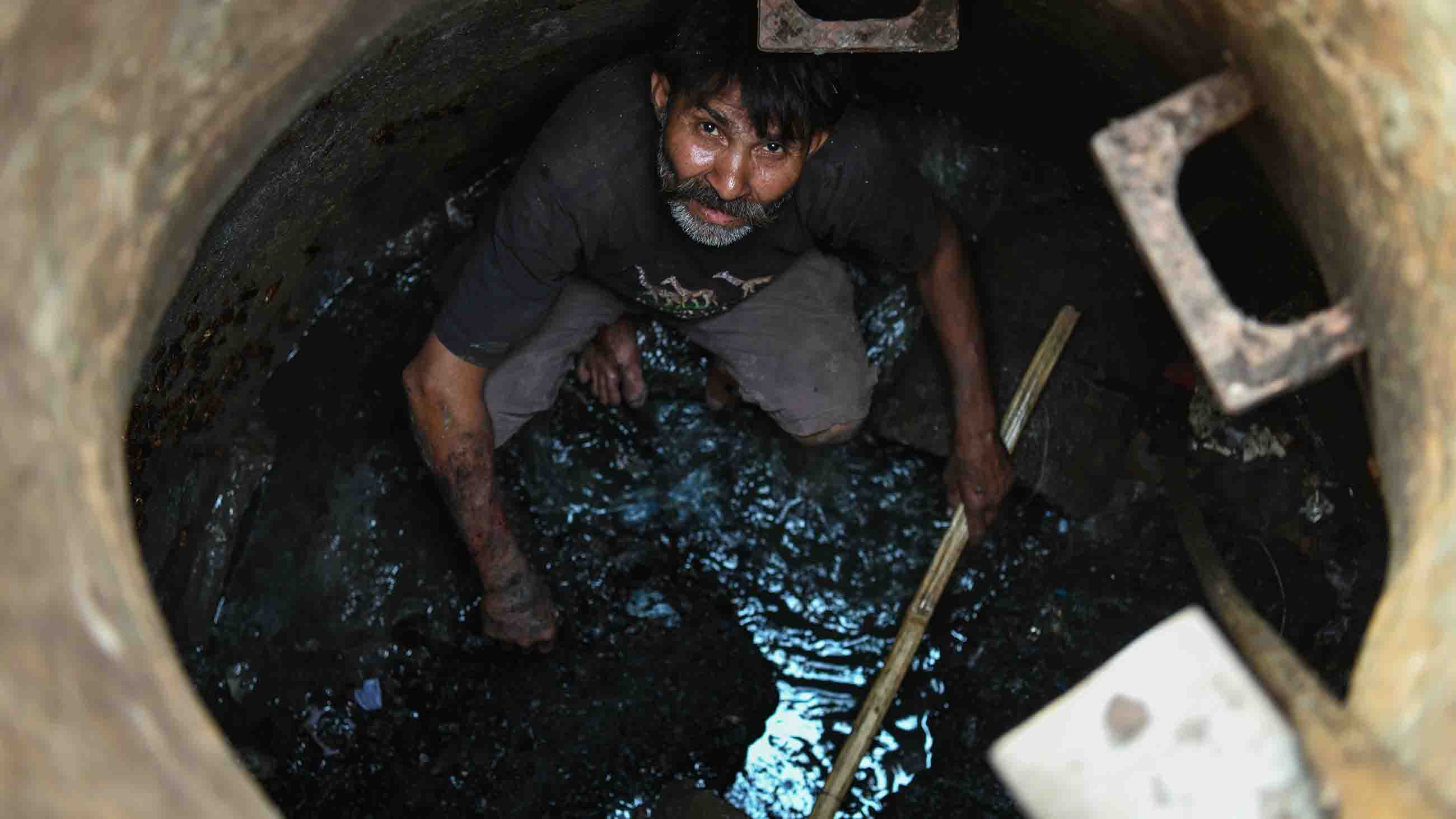
Let’s be honest we barely notice the people who keep our cities from falling apart. The ones in the heat, in the stink, in the mess making sure we can walk, drive, and scroll in peace. In India, that’s over five million sanitation workers. They clean our streets, unclog our drains, and handle our waste. Yet most live without safety gear, fair pay, or even basic respect.
When I visited the Pirana dump, the reality hit hard. I sat with workers and their families, listened to their stories, and saw how the system quietly fails them every day. Wages disappear through middlemen. Gloves and masks? Often “out of stock.” And most workers don’t even know about the rights or benefits they should already have. Three problems echoed again and again money that never arrives, danger that never ends, and information that never reaches.
That’s where Setu started. Not as an app idea on my laptop, but in the dust and noise of real conversations. The workers built it with me their needs, their words, their frustrations. Together, we imagined something simple: what if every worker could get paid directly, have a digital ID they actually owned, receive safety alerts instantly, and finally understand their rights?
So Setu isn’t just another platform. It’s a bridge built with them, for them. A step toward dignity, fairness, and finally being seen in the city they’ve kept standing all along.
Let’s be honest we barely notice the people who keep our cities from falling apart. The ones in the heat, in the stink, in the mess making sure we can walk, drive, and scroll in peace. In India, that’s over five million sanitation workers. They clean our streets, unclog our drains, and handle our waste. Yet most live without safety gear, fair pay, or even basic respect.
When I visited the Pirana dump, the reality hit hard. I sat with workers and their families, listened to their stories, and saw how the system quietly fails them every day. Wages disappear through middlemen. Gloves and masks? Often “out of stock.” And most workers don’t even know about the rights or benefits they should already have. Three problems echoed again and again money that never arrives, danger that never ends, and information that never reaches.
That’s where Setu started. Not as an app idea on my laptop, but in the dust and noise of real conversations. The workers built it with me their needs, their words, their frustrations. Together, we imagined something simple: what if every worker could get paid directly, have a digital ID they actually owned, receive safety alerts instantly, and finally understand their rights?
So Setu isn’t just another platform. It’s a bridge built with them, for them. A step toward dignity, fairness, and finally being seen in the city they’ve kept standing all along.
The Challenge
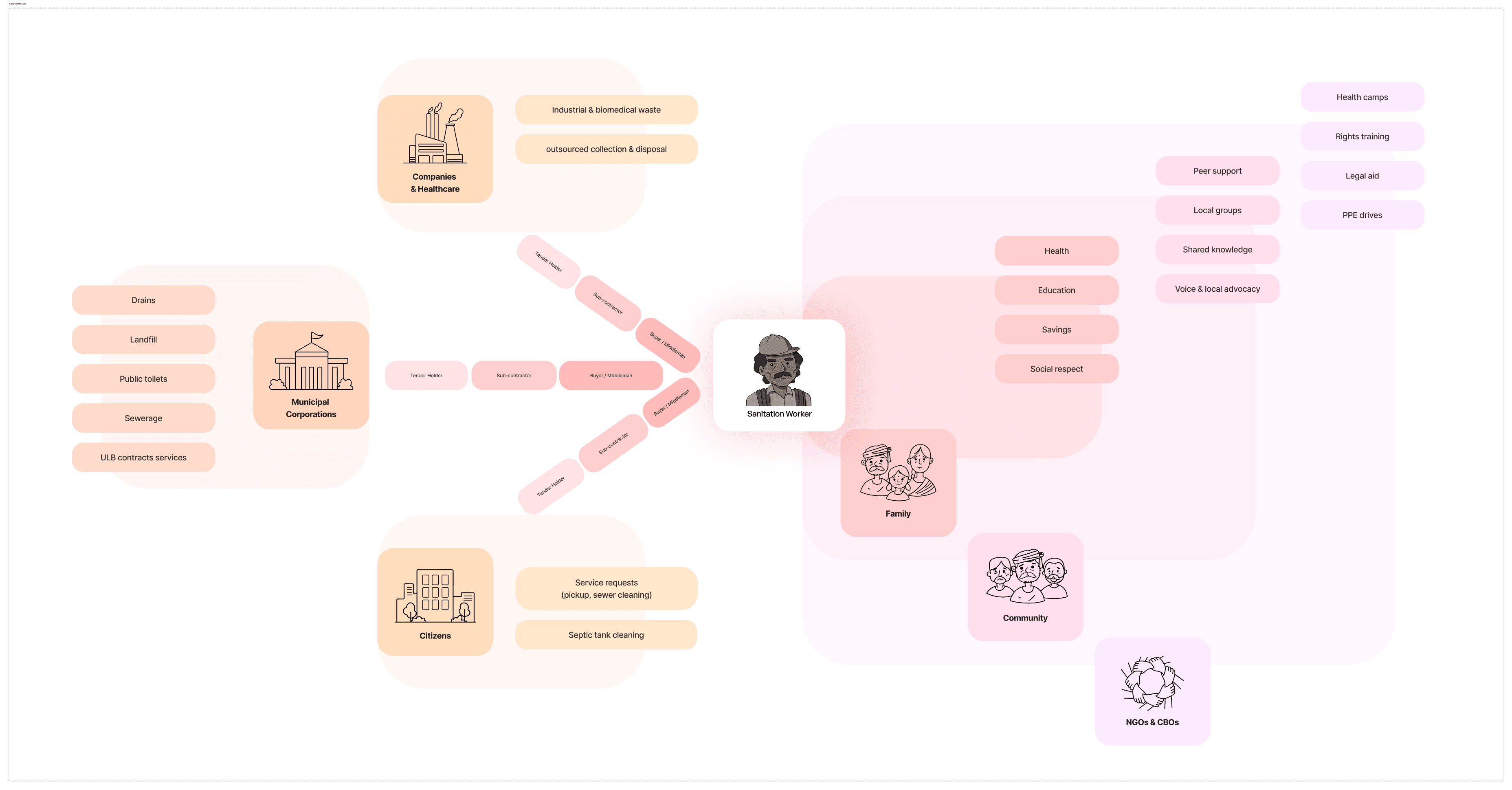
Here’s the thing sanitation in India isn’t just dirty work, it’s tangled work. Millions of people clean our streets, unclog our drains, and sort our waste, but the system they sit inside? Total chaos. Layers of contractors, municipalities, and citizens all pulling strings in different directions. The result: invisible labour, unsafe jobs, and people doing the city’s dirtiest work without the dignity they deserve.
Now, I wasn’t here to make another “solution-looking” app and call it a day. The real question was where does design actually belong in this mess? Can it step in without taking over? Can it listen before it speaks?
My challenge was to find those small but powerful points where design could quietly make a difference where it could help workers feel seen, safer, and respected. Not by designing for them, but by designing with them.
The Story
Let’s be honest we barely notice the people who keep our cities from falling apart. The ones in the heat, in the stink, in the mess making sure we can walk, drive, and scroll in peace. In India, that’s over five million sanitation workers. They clean our streets, unclog our drains, and handle our waste. Yet most live without safety gear, fair pay, or even basic respect.
When I visited the Pirana dump, the reality hit hard. I sat with workers and their families, listened to their stories, and saw how the system quietly fails them every day. Wages disappear through middlemen. Gloves and masks? Often “out of stock.” And most workers don’t even know about the rights or benefits they should already have. Three problems echoed again and again money that never arrives, danger that never ends, and information that never reaches.
That’s where Setu started. Not as an app idea on my laptop, but in the dust and noise of real conversations. The workers built it with me their needs, their words, their frustrations. Together, we imagined something simple: what if every worker could get paid directly, have a digital ID they actually owned, receive safety alerts instantly, and finally understand their rights?
So Setu isn’t just another platform. It’s a bridge built with them, for them. A step toward dignity, fairness, and finally being seen in the city they’ve kept standing all along.
The Challenge
Here’s the thing sanitation in India isn’t just dirty work, it’s tangled work. Millions of people clean our streets, unclog our drains, and sort our waste, but the system they sit inside? Total chaos. Layers of contractors, municipalities, and citizens all pulling strings in different directions. The result: invisible labour, unsafe jobs, and people doing the city’s dirtiest work without the dignity they deserve.
Now, I wasn’t here to make another “solution-looking” app and call it a day. The real question was where does design actually belong in this mess? Can it step in without taking over? Can it listen before it speaks?
My challenge was to find those small but powerful points where design could quietly make a difference where it could help workers feel seen, safer, and respected. Not by designing for them, but by designing with them.
Here’s the thing sanitation in India isn’t just dirty work, it’s tangled work. Millions of people clean our streets, unclog our drains, and sort our waste, but the system they sit inside? Total chaos. Layers of contractors, municipalities, and citizens all pulling strings in different directions. The result: invisible labour, unsafe jobs, and people doing the city’s dirtiest work without the dignity they deserve.
Now, I wasn’t here to make another “solution-looking” app and call it a day. The real question was where does design actually belong in this mess? Can it step in without taking over? Can it listen before it speaks?
My challenge was to find those small but powerful points where design could quietly make a difference where it could help workers feel seen, safer, and respected. Not by designing for them, but by designing with them.
My Process
Since I had full ownership of this project, I got to be part of everything from the first messy sketches to the last round of testing. The process wasn’t neat or linear; it twisted, looped, and shifted every time I learned something new from the people I was designing with. What you’ll see here is a snapshot of the key moments that really shaped where the project went.
Since I had full ownership of this project, I got to be part of everything from the first messy sketches to the last round of testing. The process wasn’t neat or linear; it twisted, looped, and shifted every time I learned something new from the people I was designing with. What you’ll see here is a snapshot of the key moments that really shaped where the project went.
Research & Observation
Before jumping into ideas, I had to stop and listen. Not to the noise of data, but to the people who live this reality every day.
Secondary Research
We dug through research papers, news articles, and even social media posts to trace how sanitation workers are spoken about and how rarely they get to speak for themselves. I started with what was already out there reports from the World Bank, ILO, and Gates Foundation. The numbers were clear and painful: The job is dangerous. Sewer workers face toxic gases, infections, and sometimes death. Over 90% of sanitation jobs in India are informal no job security, no health cover. Laws exist, but barely anyone knows about them. Government schemes exist too, but poor digital access keeps them out of reach.
Primary Research
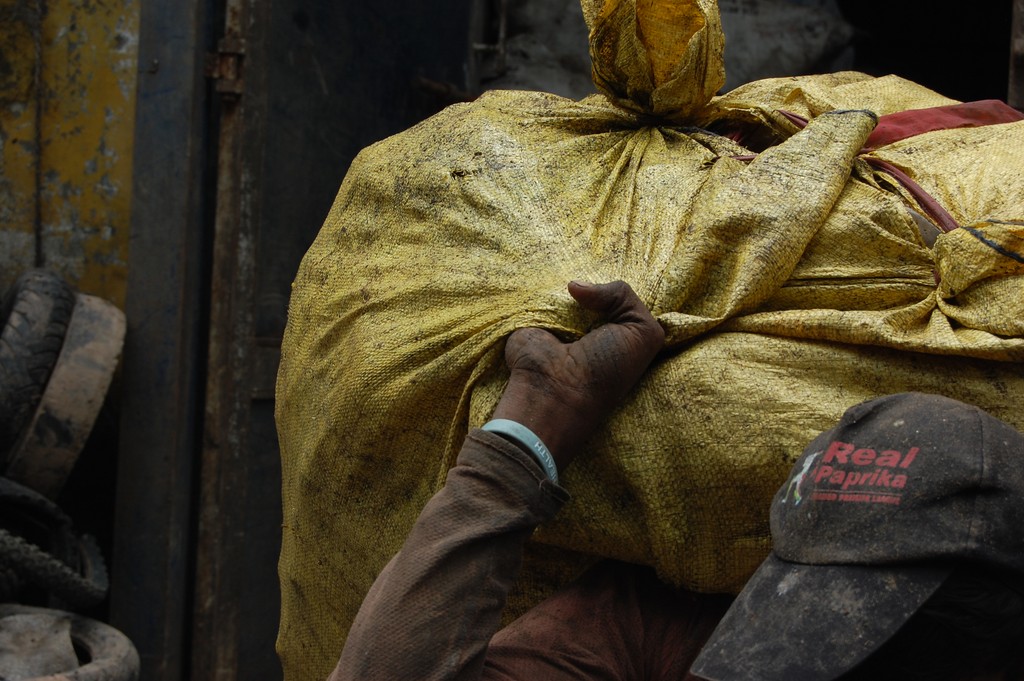
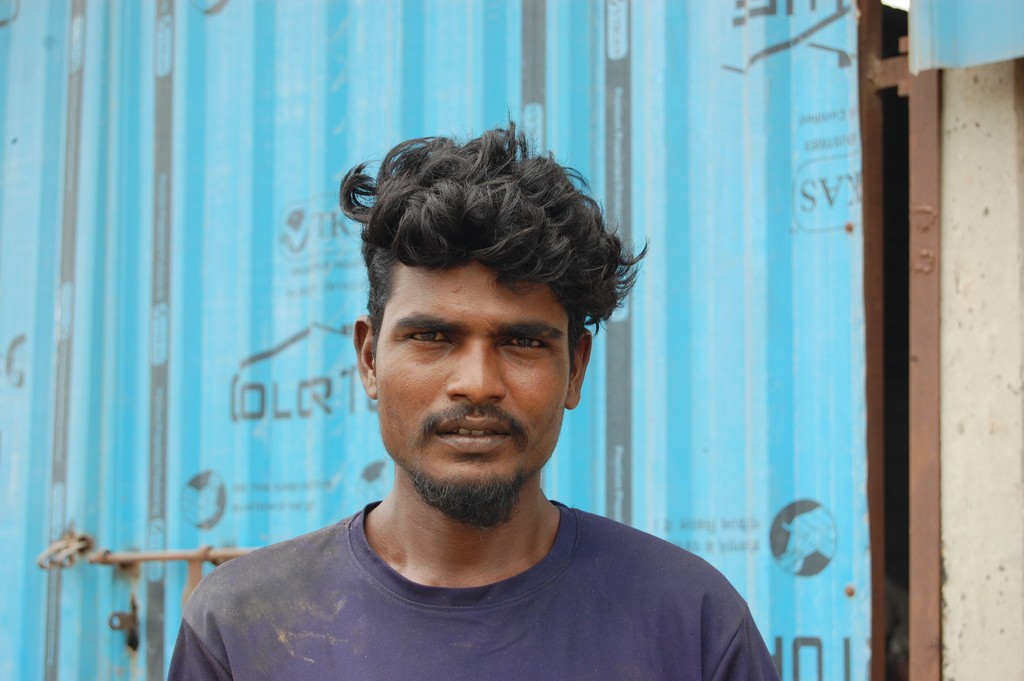
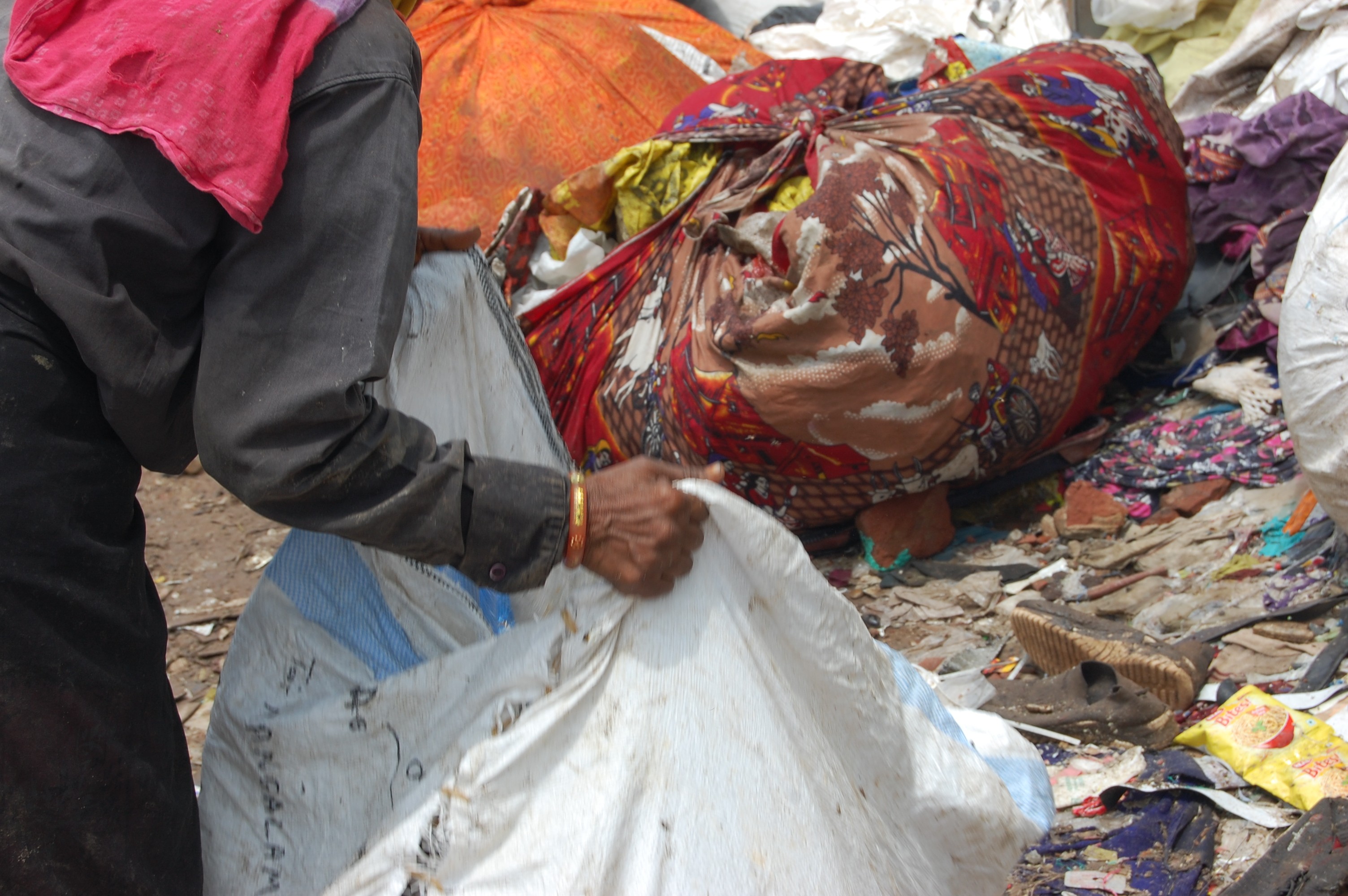
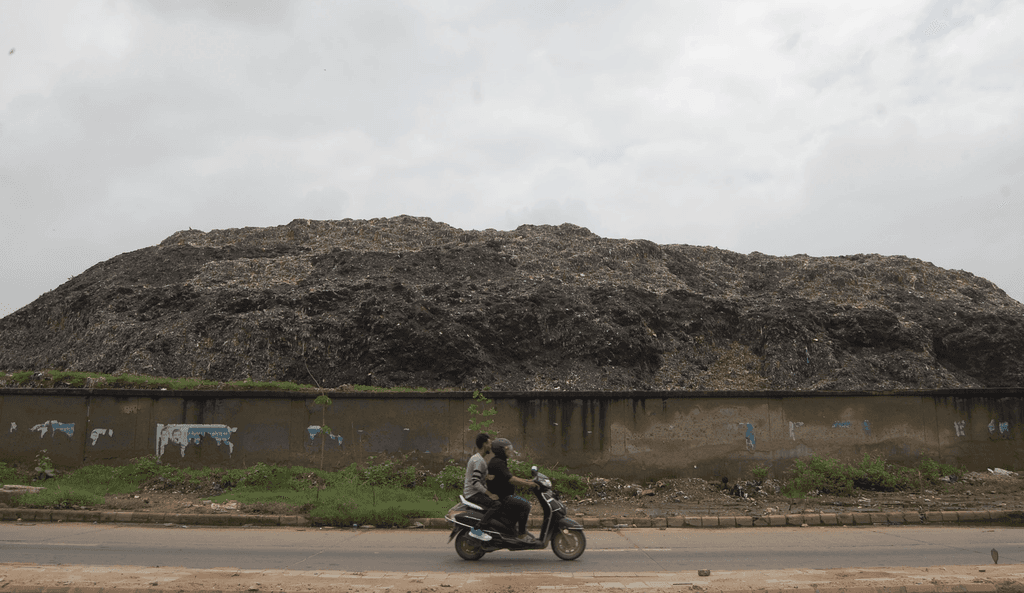
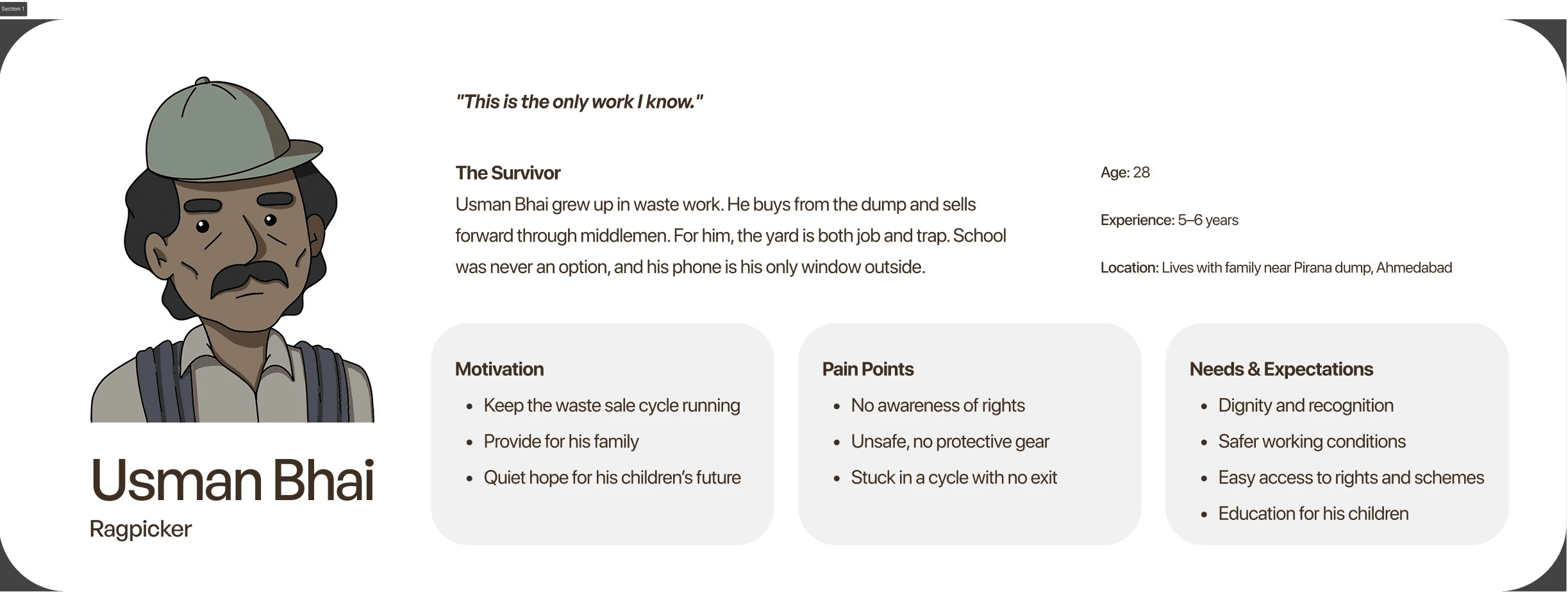
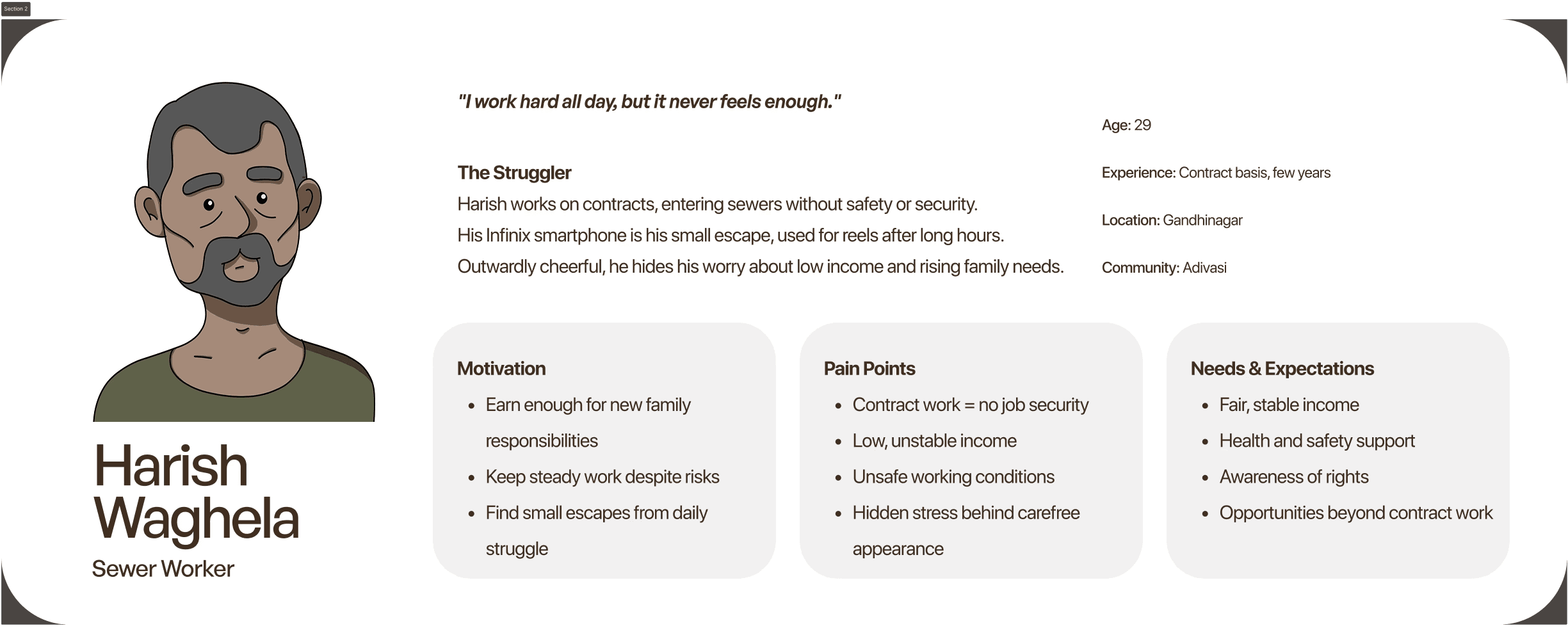
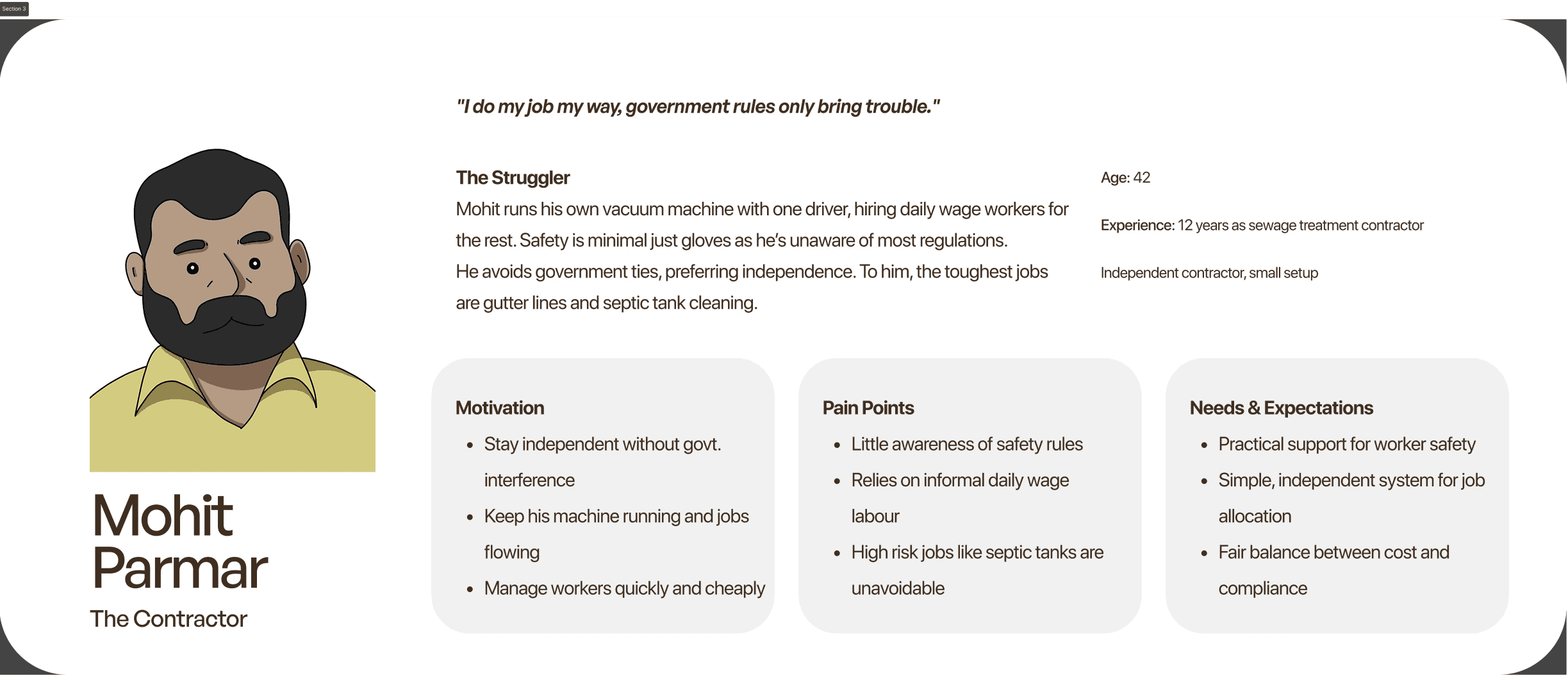
Then came the part that mattered most meeting the people behind those numbers. I went to the Pirana dump yard in Ahmedabad and spoke with: Waste pickers who sell recyclables by weight. Their earnings swing wildly, and middlemen often take the bigger cut. Sewer workers who still climb into manholes with nothing but gloves. One said, “We know it’s dangerous, but what choice do we have?” Contractors managing vacuum trucks and daily wagers, most trying to avoid government paperwork even if it means cutting corners on safety.
On the ground
Here’s what stood out:
Almost everyone owns a basic smartphone used mostly for calls, WhatsApp, and reels. There’s digital potential, but the gap is real. Families live near the worksites. Kids play around the same spaces their parents clean. Education keeps coming up as a quiet worry. Most of all, no one asked for help. They asked for fairness to be seen, to be safe, to be paid right. That’s when it clicked. This project wasn’t about “designing for users.” It was about standing next to them, understanding their world, and building something that fits into it not something that forces its way in.
Before jumping into ideas, I had to stop and listen. Not to the noise of data, but to the people who live this reality every day.
Secondary Research
We dug through research papers, news articles, and even social media posts to trace how sanitation workers are spoken about and how rarely they get to speak for themselves. I started with what was already out there reports from the World Bank, ILO, and Gates Foundation. The numbers were clear and painful: The job is dangerous. Sewer workers face toxic gases, infections, and sometimes death. Over 90% of sanitation jobs in India are informal no job security, no health cover. Laws exist, but barely anyone knows about them. Government schemes exist too, but poor digital access keeps them out of reach.
Primary Research
Then came the part that mattered most meeting the people behind those numbers. I went to the Pirana dump yard in Ahmedabad and spoke with: Waste pickers who sell recyclables by weight. Their earnings swing wildly, and middlemen often take the bigger cut. Sewer workers who still climb into manholes with nothing but gloves. One said, “We know it’s dangerous, but what choice do we have?” Contractors managing vacuum trucks and daily wagers, most trying to avoid government paperwork even if it means cutting corners on safety.
On the ground
Here’s what stood out:
Almost everyone owns a basic smartphone used mostly for calls, WhatsApp, and reels. There’s digital potential, but the gap is real. Families live near the worksites. Kids play around the same spaces their parents clean. Education keeps coming up as a quiet worry. Most of all, no one asked for help. They asked for fairness to be seen, to be safe, to be paid right. That’s when it clicked. This project wasn’t about “designing for users.” It was about standing next to them, understanding their world, and building something that fits into it not something that forces its way in.
My Process
Since I had full ownership of this project, I got to be part of everything from the first messy sketches to the last round of testing. The process wasn’t neat or linear; it twisted, looped, and shifted every time I learned something new from the people I was designing with. What you’ll see here is a snapshot of the key moments that really shaped where the project went.
Research & Observation
Before jumping into ideas, I had to stop and listen. Not to the noise of data, but to the people who live this reality every day.
Secondary Research
We dug through research papers, news articles, and even social media posts to trace how sanitation workers are spoken about and how rarely they get to speak for themselves. I started with what was already out there reports from the World Bank, ILO, and Gates Foundation. The numbers were clear and painful: The job is dangerous. Sewer workers face toxic gases, infections, and sometimes death. Over 90% of sanitation jobs in India are informal no job security, no health cover. Laws exist, but barely anyone knows about them. Government schemes exist too, but poor digital access keeps them out of reach.
Primary Research
Then came the part that mattered most meeting the people behind those numbers. I went to the Pirana dump yard in Ahmedabad and spoke with: Waste pickers who sell recyclables by weight. Their earnings swing wildly, and middlemen often take the bigger cut. Sewer workers who still climb into manholes with nothing but gloves. One said, “We know it’s dangerous, but what choice do we have?” Contractors managing vacuum trucks and daily wagers, most trying to avoid government paperwork even if it means cutting corners on safety.
On the ground
Here’s what stood out:
Almost everyone owns a basic smartphone used mostly for calls, WhatsApp, and reels. There’s digital potential, but the gap is real. Families live near the worksites. Kids play around the same spaces their parents clean. Education keeps coming up as a quiet worry. Most of all, no one asked for help. They asked for fairness to be seen, to be safe, to be paid right. That’s when it clicked. This project wasn’t about “designing for users.” It was about standing next to them, understanding their world, and building something that fits into it not something that forces its way in.
Initial Hypothesis / Goal
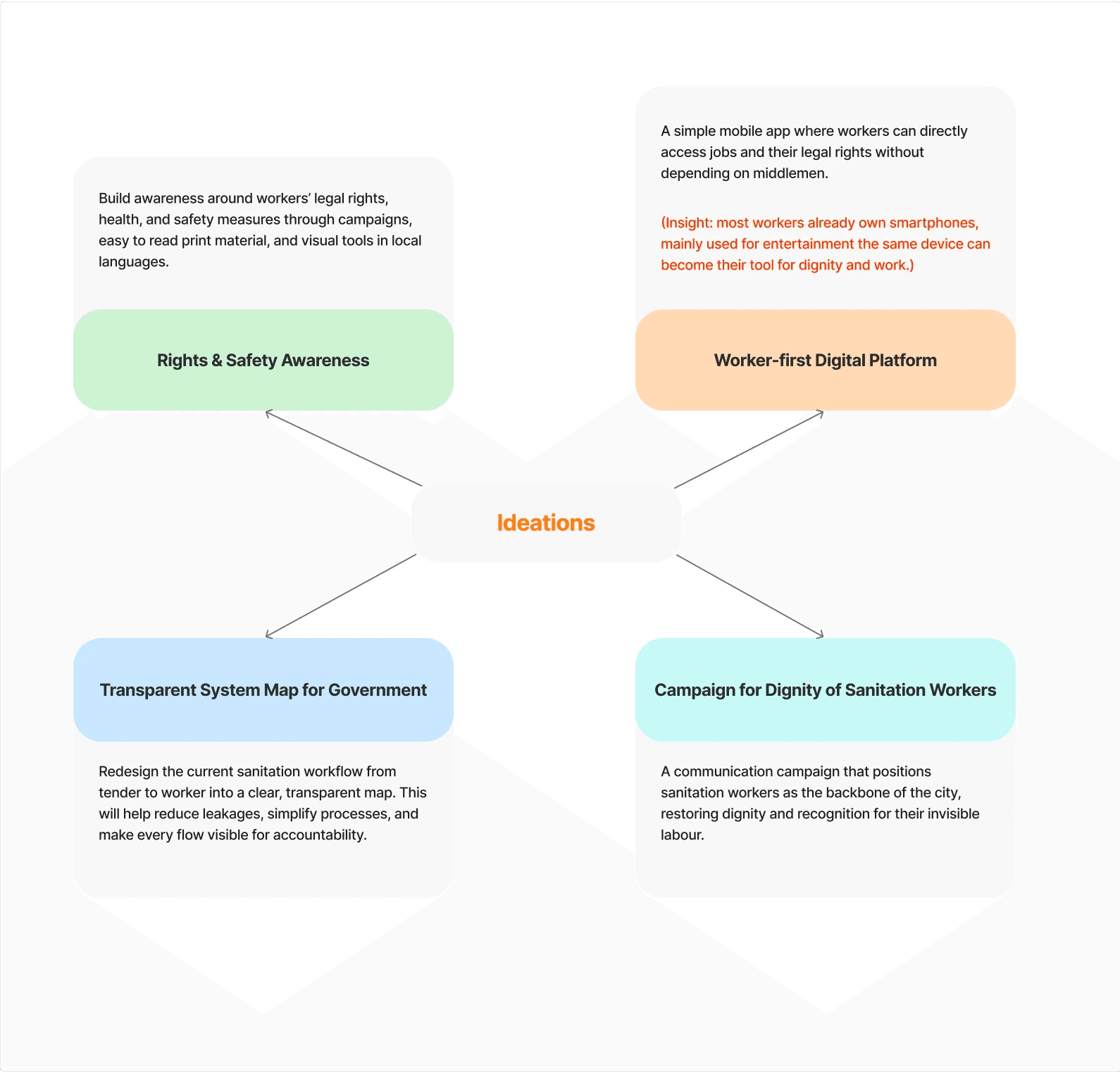
It started with one truth sanitation workers are unheard. Their rights are unclear, their health is at risk, and their dignity rarely finds space in the conversation. The real problem isn’t just unsafe work, it’s the system that keeps them unseen. My goal was simple: to use design as a way to make them visible again. To find small ways to spread awareness, spark recognition, and build a little more dignity into a space that’s forgotten too easily.
Competitor Analysis
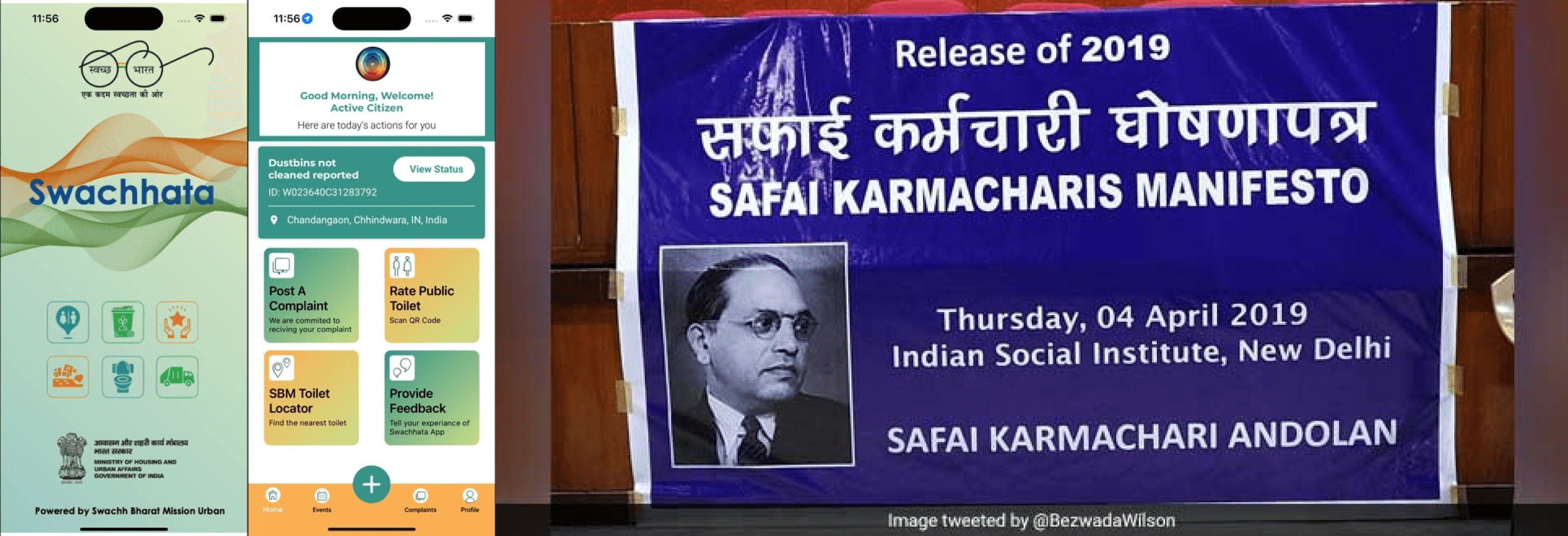
When I started looking at what’s already out there for sanitation and informal workers, three kinds of platforms kept showing up government apps, NGO efforts, and gig platforms.
Government apps like Swachhata-MoHUA are built for citizens to file complaints, not for workers to actually earn better or learn about their rights.
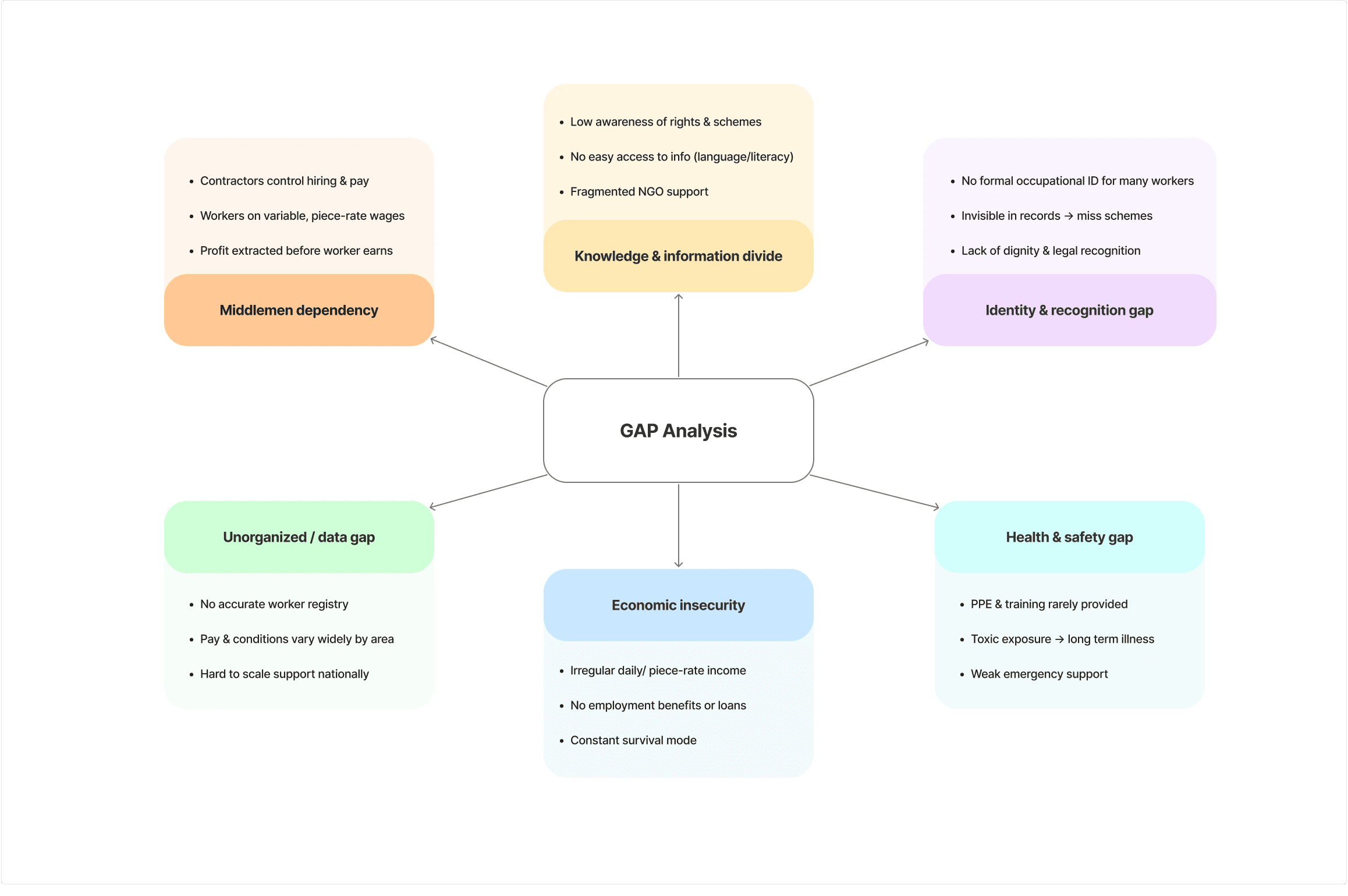
NGOs like Safai Karamchari Andolan have done amazing advocacy, but most of their impact stays offline powerful, yet limited in reach. And gig platforms? They focus on convenience for users, not on safety or dignity for the people doing the work. So here’s the gap no one’s designing with workers in mind. There’s no space that puts their income, safety, and rights at the center.
That’s exactly the space this project steps into building something that starts with the worker, not the system.
Redefined Problem/Goal
The goal was clear build something for the worker, around the worker.
A digital space where they can earn directly, understand their rights, and stay safer every day without depending on anyone else to make that happen.
But it’s more than just an app or a feature list. It’s about visibility. About giving back the dignity that’s been missing. About reminding the city who really keeps it running and making sure those people finally get their share of fairness and respect.
Initial Hypothesis / Goal
It started with one truth sanitation workers are unheard. Their rights are unclear, their health is at risk, and their dignity rarely finds space in the conversation. The real problem isn’t just unsafe work, it’s the system that keeps them unseen.
My goal was simple: to use design as a way to make them visible again. To find small ways to spread awareness, spark recognition, and build a little more dignity into a space that’s forgotten too easily.
Competitor Analysis
When I started looking at what’s already out there for sanitation and informal workers, three kinds of platforms kept showing up government apps, NGO efforts, and gig platforms. Government apps like Swachhata-MoHUA are built for citizens to file complaints, not for workers to actually earn better or learn about their rights.
NGOs like Safai Karamchari Andolan have done amazing advocacy, but most of their impact stays offline powerful, yet limited in reach. And gig platforms? They focus on convenience for users, not on safety or dignity for the people doing the work. So here’s the gap no one’s designing with workers in mind. There’s no space that puts their income, safety, and rights at the center.
That’s exactly the space this project steps into building something that starts with the worker, not the system.
Redefined Problem/Goal
The goal was clear build something for the worker, around the worker.
A digital space where they can earn directly, understand their rights, and stay safer every day without depending on anyone else to make that happen.
But it’s more than just an app or a feature list. It’s about visibility. About giving back the dignity that’s been missing. About reminding the city who really keeps it running and making sure those people finally get their share of fairness and respect.
User Personas
User Personas
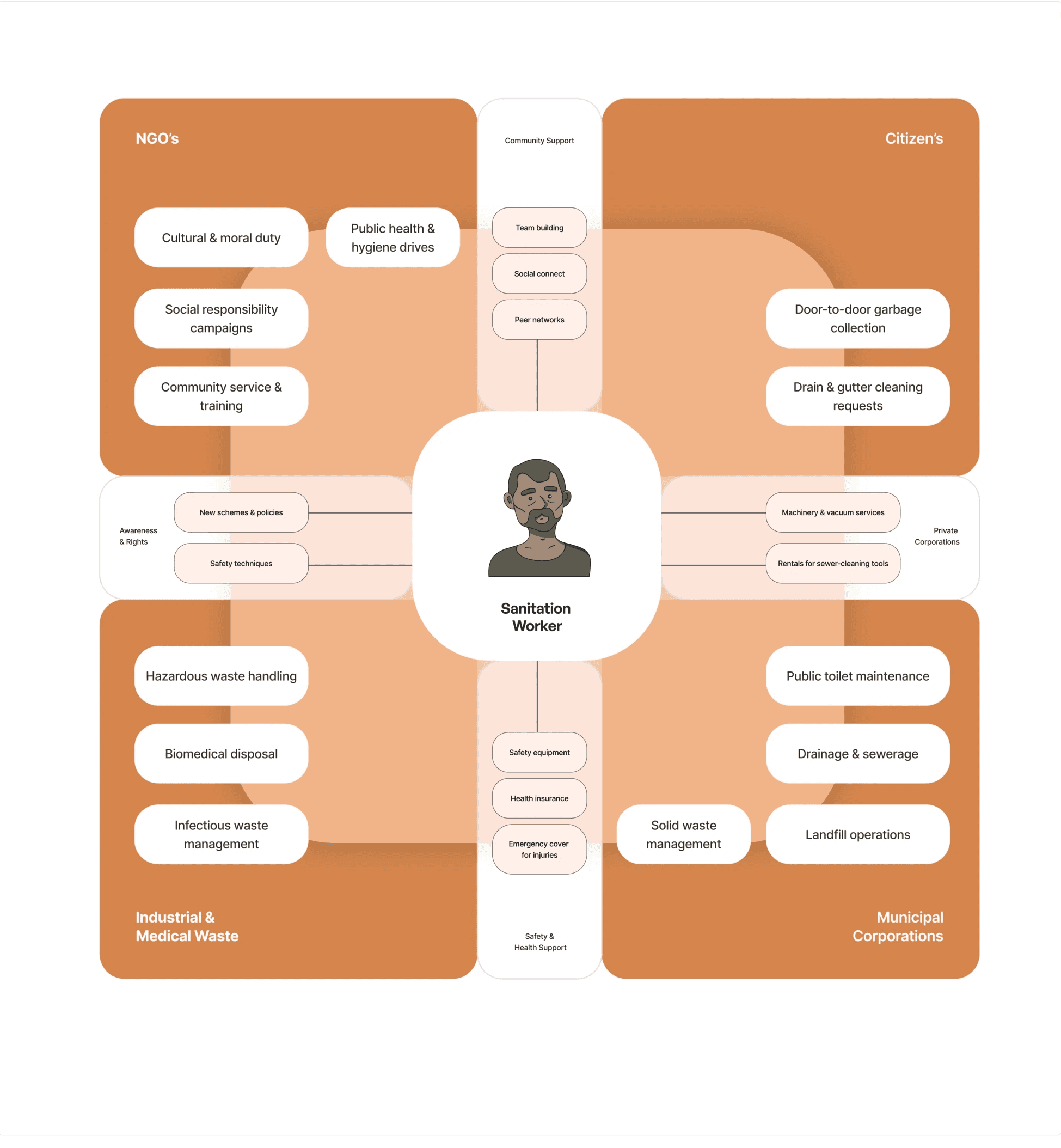
System
System
Cause Map
Cause Map
Ideations
Ideations
Offered System
Offered System
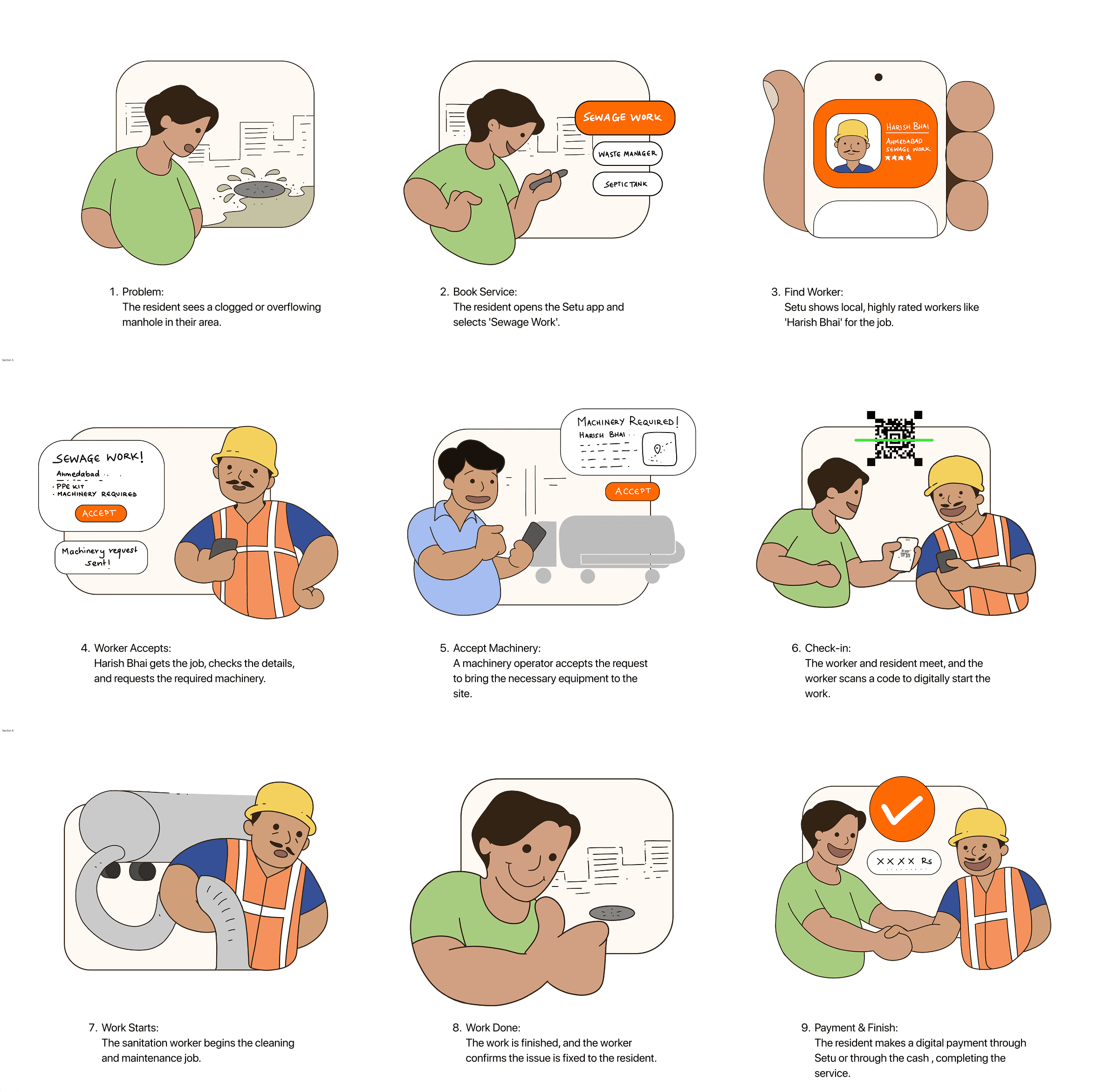
The Journey
The Journey
Design & Prototype
Design & Prototype
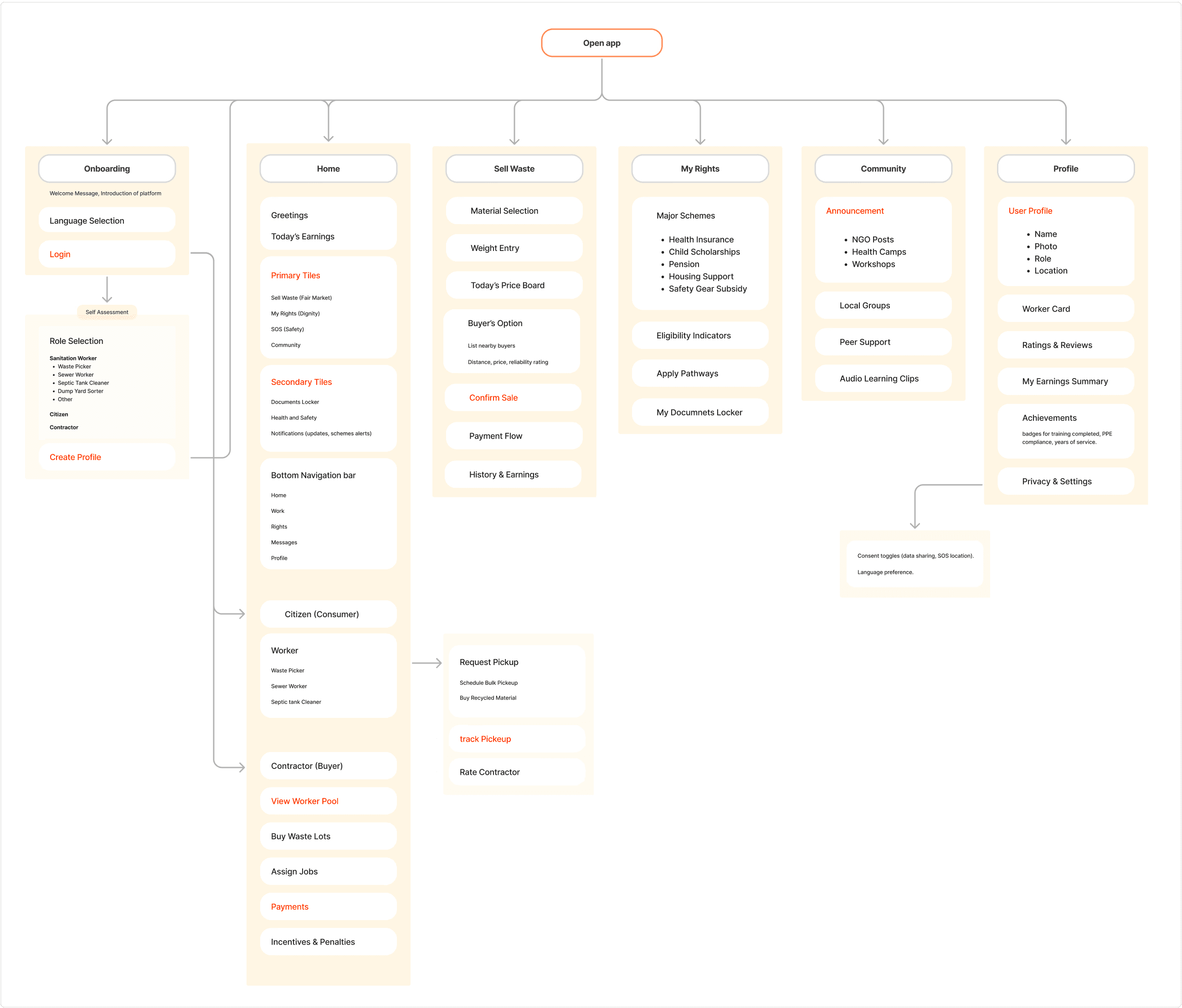
Information Architecture
Information Architecture
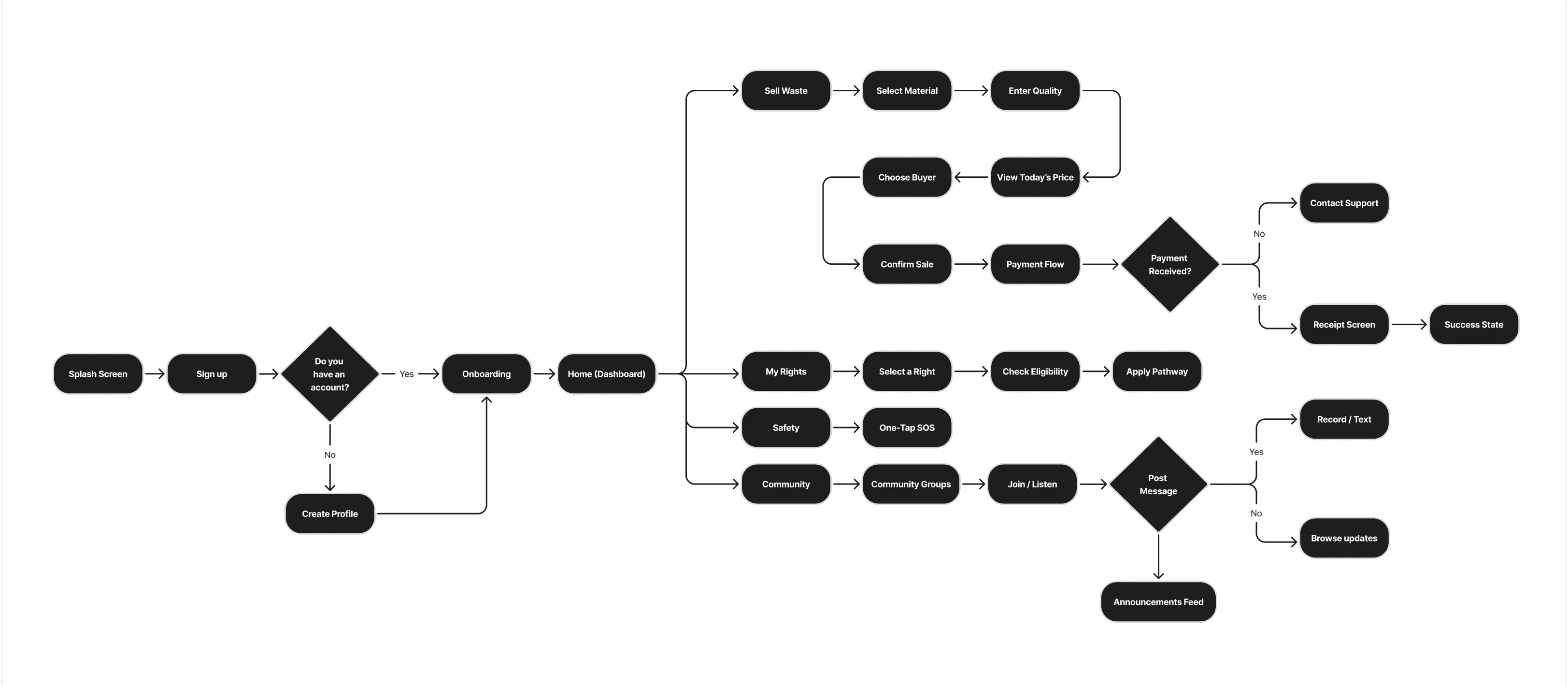
User Flows
User Flows
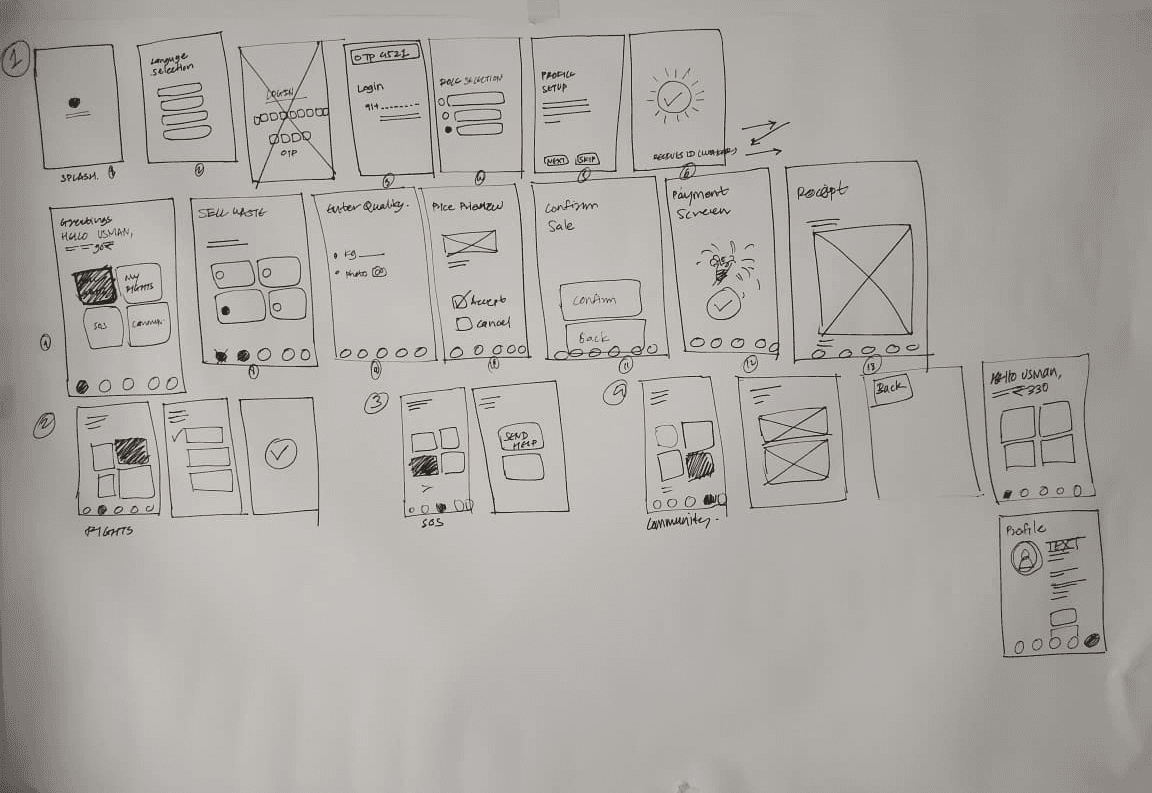
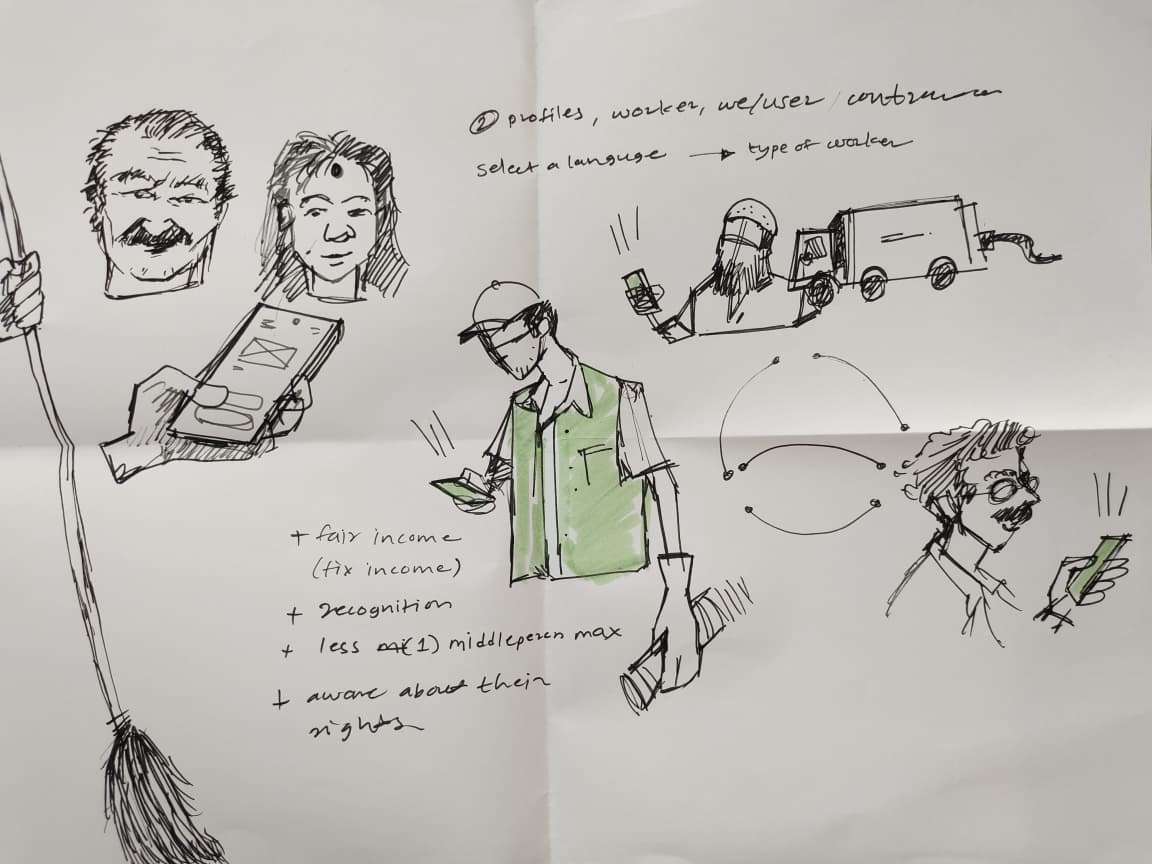
Interface Ideation & Wireframes
When I started sketching the platform, I tried to see it through a sanitation worker’s day not a designer’s lens. The app needed to feel simple, direct, and genuinely useful. Something they could open without worry or confusion.
That meant stripping away anything extra. Clear flows. Familiar visuals. No clutter. The aim wasn’t to make a new “tech tool” they’d have to figure out it was to design something that blended naturally into their work routine, almost like a quiet helper in the background.
Design Patterns
Design Patterns
Presenting Setu
Presenting Setu
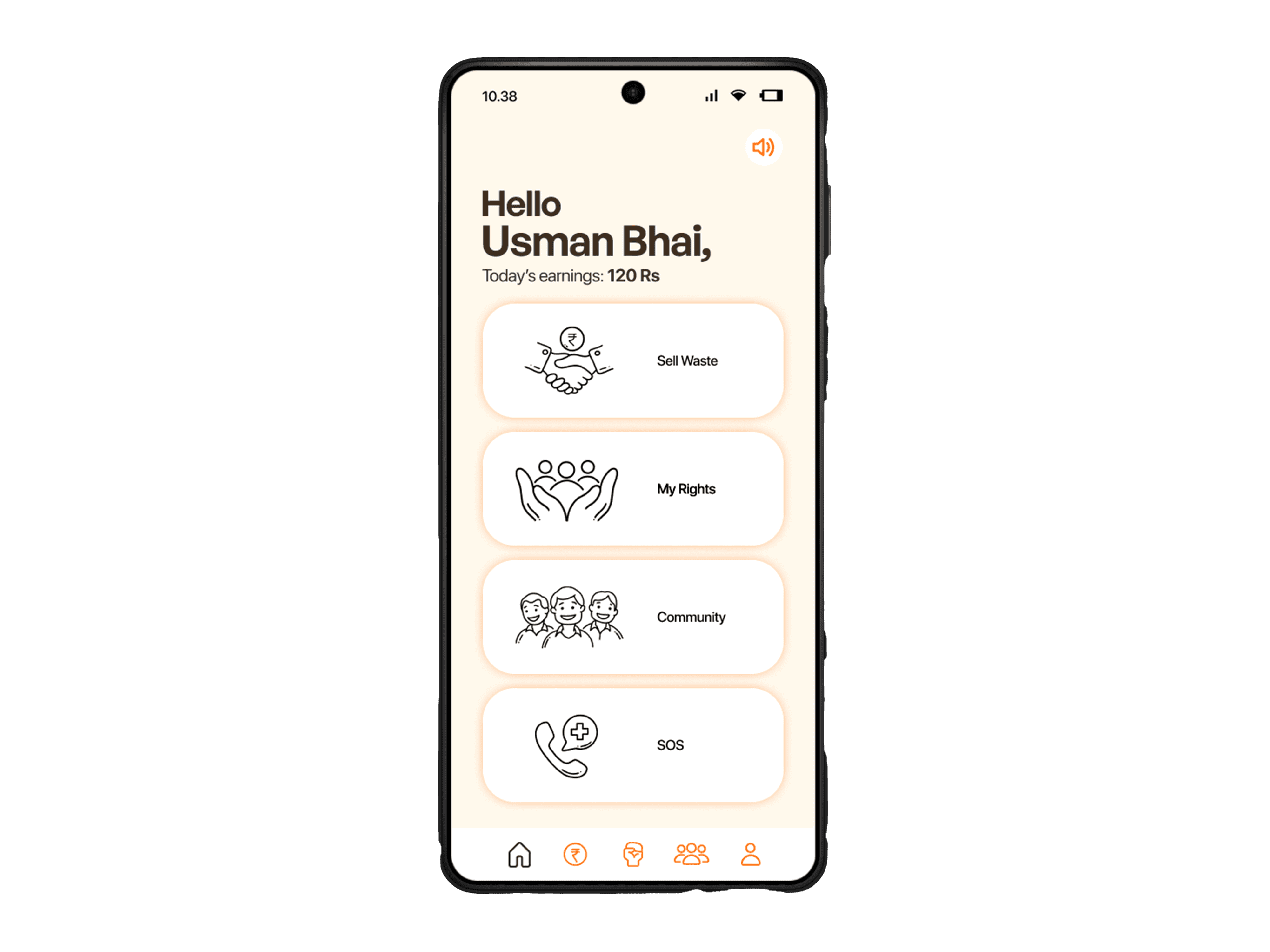
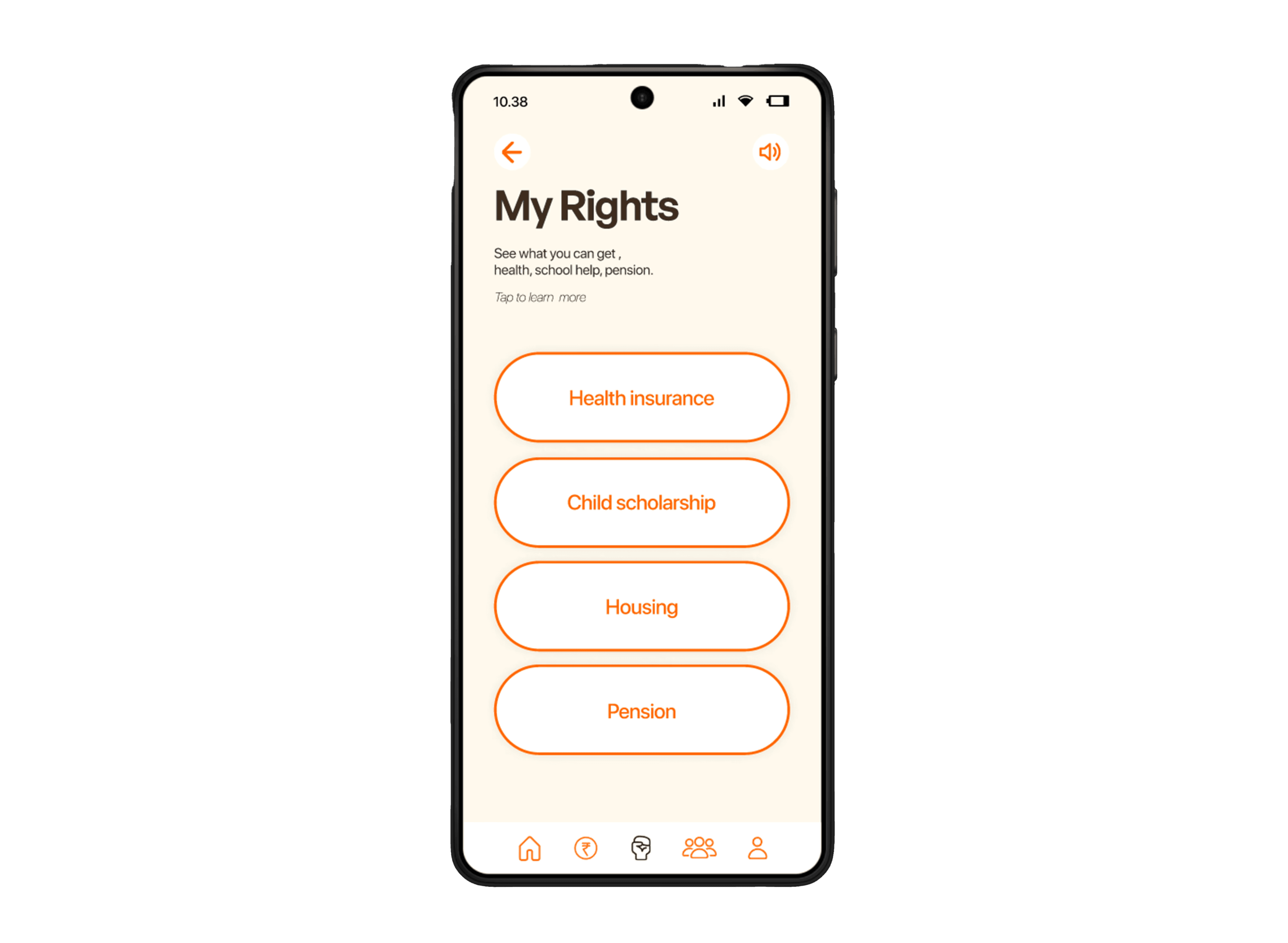
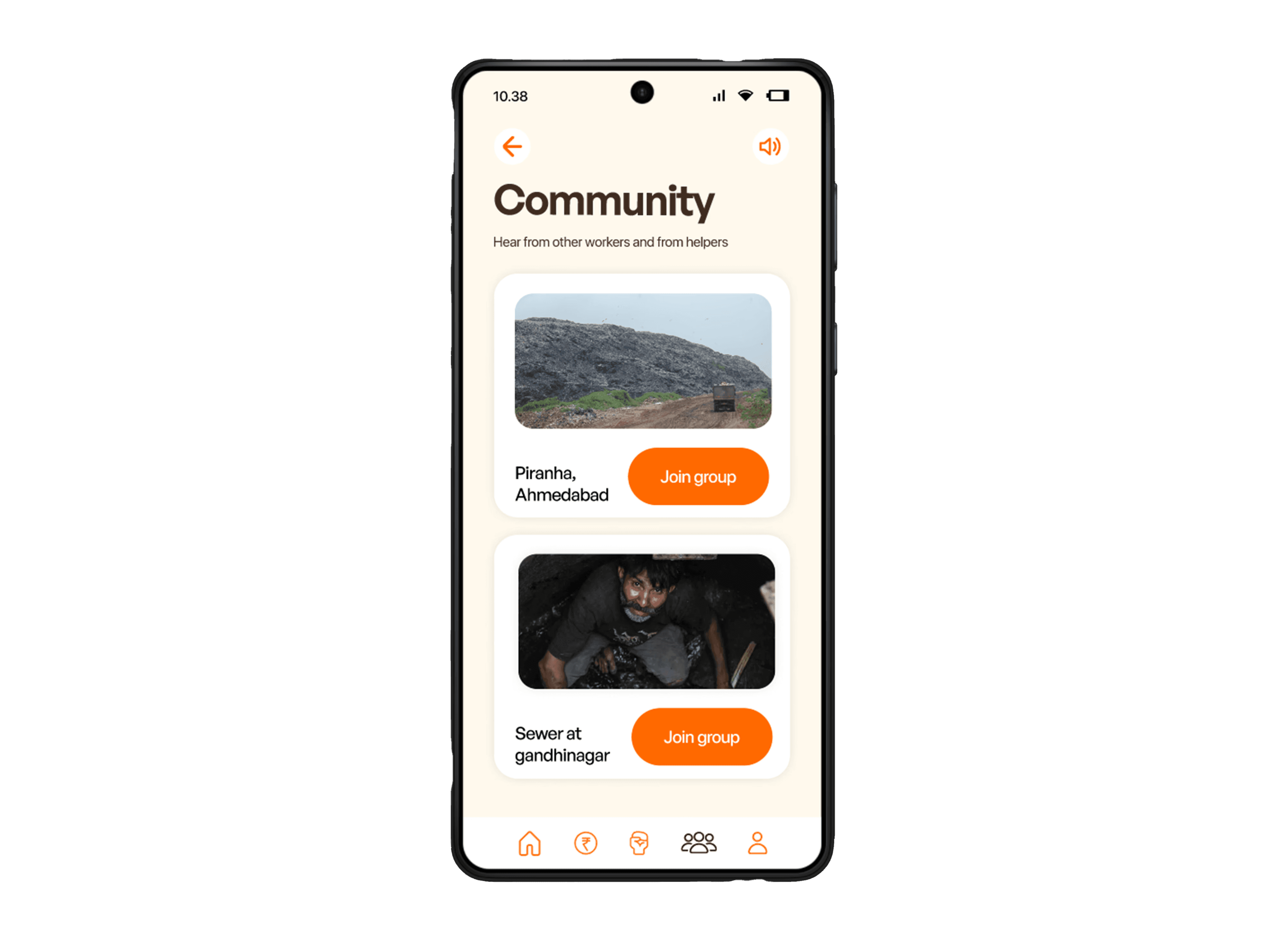
The platform is built around three key features that shape a sanitation worker’s daily life. Sell Waste lets them log what they collect and instantly see their earnings no middlemen, no confusion, just clarity and control. Community creates a shared space to connect, learn, and support one another, turning isolation into solidarity. And My Rights brings crucial legal and safety information into their hands in plain language, helping them make informed decisions and stand up for fair treatment. Together, these features build trust, dignity, and empowerment—one tap at a time.
Testing & Feedback
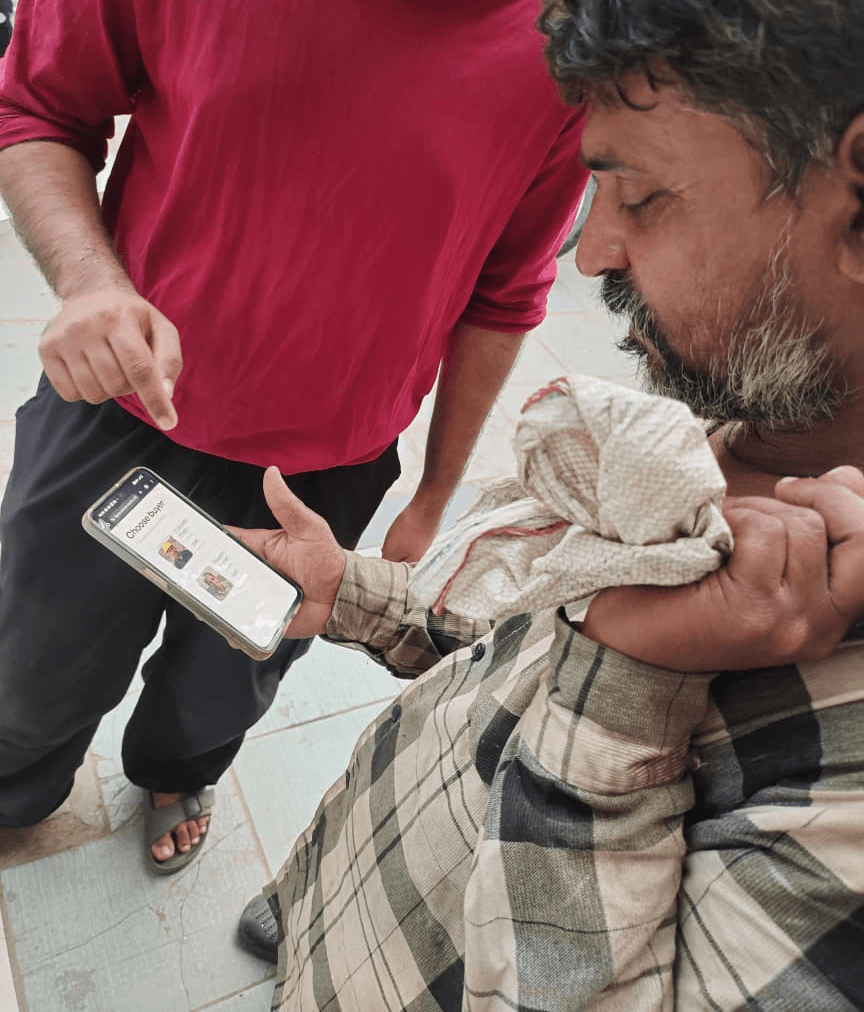
Turns out, the app wasn’t rocket science workers found it simple and easy to use. But of course, they had thoughts, and some of them were eye opening:
Terminology: A few labels confused them at first. But “Sell Waste” and “My Rights”? Those clicked immediately. Lesson learned: stick to what makes sense to them, not fancy jargon.
First Impressions: At first, the flow felt… different. Not like their usual selling to the sheth. But after trying it out, they said it actually made sense. Intuitive wins.
Daily Income: One worker did the math on the spot direct selling with transparent rates could give him an extra ₹30–40 a day. His takeaway? “It will be helpful for us to grow our income.”
User Testing
I brought a high-fidelity prototype back to the field and watched 6 workers take it for a spin. Usability score?
8.5/10.
Not bad, right?
They also shared some small but mighty improvements:
Keep labels consistent confusion kills adoption. Make first-time flows familiar, not overwhelming. Core actions like selling waste or checking rights must stay effortless, so the app doesn’t distract from their actual work.
What hit me most? The feedback confirmed the platform was heading in the right direction, but tiny tweaks could make a massive difference in daily life. One lesson stands out: design only works when it actually listens to real people, not assumptions.
Interactive Prototype
My Reflection
Working on this project? Grounding. Transformative. Eye-opening. I started with a simple concern: how do we give sanitation workers dignity, safety, and fair pay? What I ended up with was a full system shaped by persistence, empathy, and a lot of listening. Immersion was everything. Spending time at the Pirana dump, watching workers handle waste, talking to contractors, hearing families’ struggles these were insights no report or assumption could ever give me. Even little things, like how they used their smartphones or how kids navigated life around the dumps, shaped the design in ways I never expected.
Co-creation mattered just as much. Workers shared their daily challenges, their hopes, their reactions to early ideas. Every conversation became a thread in the solution. It reminded me, design isn’t something you do for people it’s something you build with them. This project hammered home one big truth, good design isn’t just about usability or workflows. It’s about inclusion, respect, and amplifying voices that are too often invisible. In the end, this wasn’t just an app. It was turning everyday struggles into real, meaningful change showing that thoughtful design can bring dignity and fairness where it’s been missing for far too long.
The platform is built around three key features that shape a sanitation worker’s daily life. Sell Waste lets them log what they collect and instantly see their earnings no middlemen, no confusion, just clarity and control. Community creates a shared space to connect, learn, and support one another, turning isolation into solidarity. And My Rights brings crucial legal and safety information into their hands in plain language, helping them make informed decisions and stand up for fair treatment. Together, these features build trust, dignity, and empowerment—one tap at a time.
Interface Ideation & Wireframes
When I started sketching the platform, I tried to see it through a sanitation worker’s day not a designer’s lens. The app needed to feel simple, direct, and genuinely useful. Something they could open without worry or confusion.
That meant stripping away anything extra. Clear flows. Familiar visuals. No clutter. The aim wasn’t to make a new “tech tool” they’d have to figure out it was to design something that blended naturally into their work routine, almost like a quiet helper in the background.
Testing & Feedback
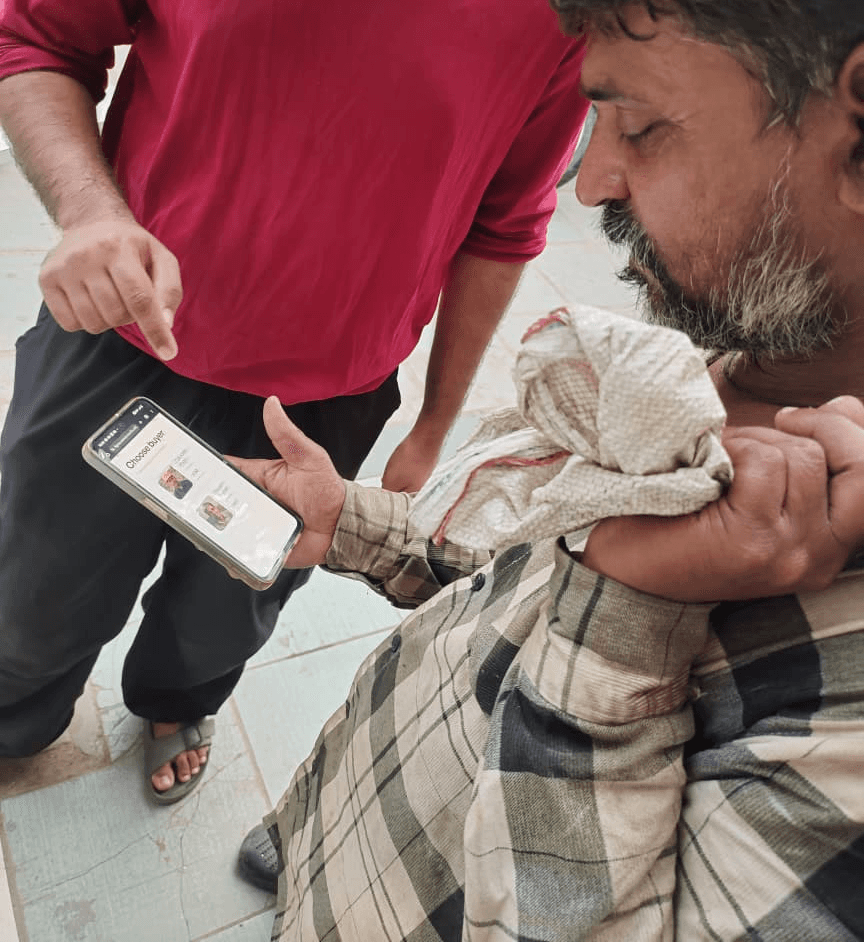
Turns out, the app wasn’t rocket science workers found it simple and easy to use. But of course, they had thoughts, and some of them were eye opening:
Terminology: A few labels confused them at first. But “Sell Waste” and “My Rights”? Those clicked immediately. Lesson learned: stick to what makes sense to them, not fancy jargon.
First Impressions: At first, the flow felt… different. Not like their usual selling to the sheth. But after trying it out, they said it actually made sense. Intuitive wins.
Daily Income: One worker did the math on the spot direct selling with transparent rates could give him an extra ₹30–40 a day. His takeaway? “It will be helpful for us to grow our income.”
User Testing
I brought a high-fidelity prototype back to the field and watched 6 workers take it for a spin. Usability score?
8.5/10.
Not bad, right?
They also shared some small but mighty improvements:
Keep labels consistent confusion kills adoption. Make first-time flows familiar, not overwhelming. Core actions like selling waste or checking rights must stay effortless, so the app doesn’t distract from their actual work.
What hit me most? The feedback confirmed the platform was heading in the right direction, but tiny tweaks could make a massive difference in daily life. One lesson stands out: design only works when it actually listens to real people, not assumptions.
Interactive Prototype